The alarm
When something looks or sounds threatening, the amygdala reacts almost at once. Studies in animals found two routes into it: a fast, rough one straight from the thalamus, and a slower, detailed one through the cortex.1ReviewEmotion circuits in the brainLeDoux, J. E. · 2000
The fast route is why you can flinch at a stick on the path before you realise it is not a snake.
The body gets ready
The amygdala signals the hypothalamus and the brainstem, which speed up the heart and breathing and trigger the release of stress hormones such as adrenaline. Muscles tense and attention narrows on the threat.1ReviewEmotion circuits in the brainLeDoux, J. E. · 20002TextbookPrinciples of Neural Science, 6th editionKandel, E. R., Koester, J. D., Mack, S. H. & Siegelbaum, S. A. · 2021
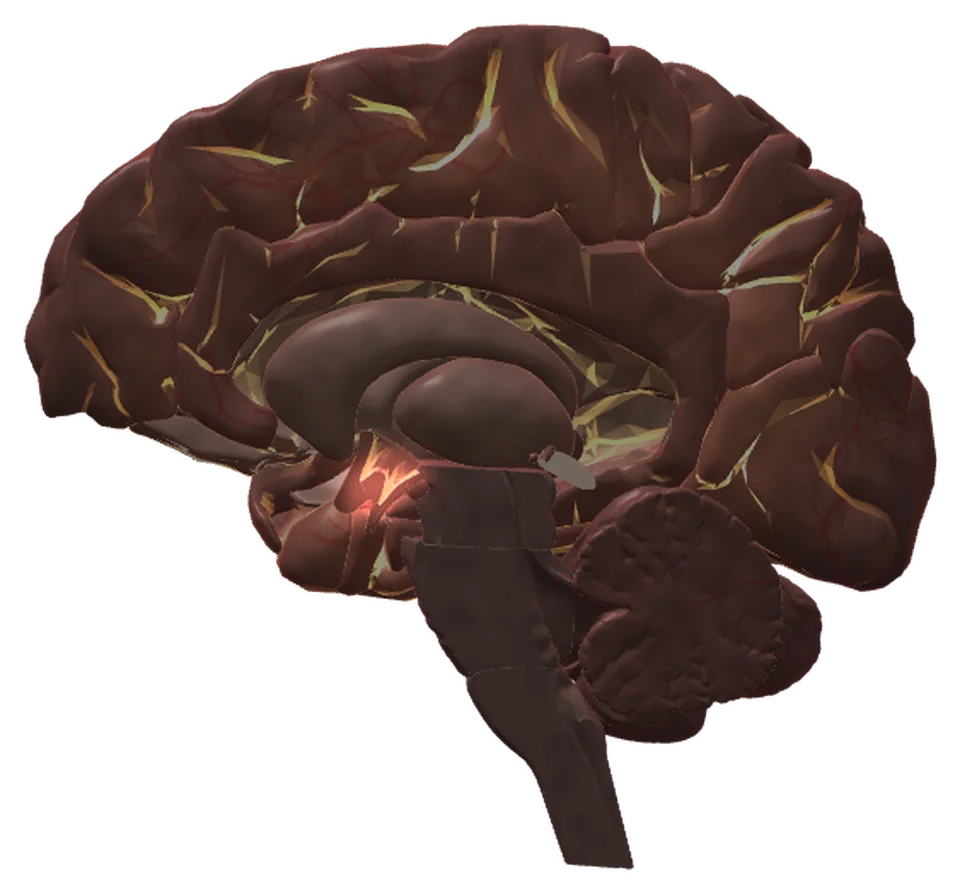
Calming down
Once a threat turns out to be harmless, the fear has to be switched off. In rats, neurons in the medial prefrontal cortex become active when an animal learns that a warning sign is now safe, helping to hold the fear response back.3Peer-reviewed studyNeurons in medial prefrontal cortex signal memory for fear extinctionMilad, M. R. & Quirk, G. J. · 2002
A life without fear
A woman known as S.M., whose amygdala on both sides was destroyed by a rare disease, shows almost no fear. In studies she handled snakes and spiders and walked through a haunted house without being scared.4Peer-reviewed studyThe human amygdala and the induction and experience of fearFeinstein, J. S., Adolphs, R., Damasio, A. & Tranel, D. · 2011 Her case shows how much fear normally protects us.