Sleep comes in cycles
Through the night the brain moves between deeper, slower sleep and REM sleep, in a cycle that repeats several times. When researchers in the 1950s woke people during REM, they usually reported vivid dreams.1Peer-reviewed studyThe relation of eye movements during sleep to dream activity: an objective method for the study of dreamingDement, W. & Kleitman, N. · 1957
Who flips the switch
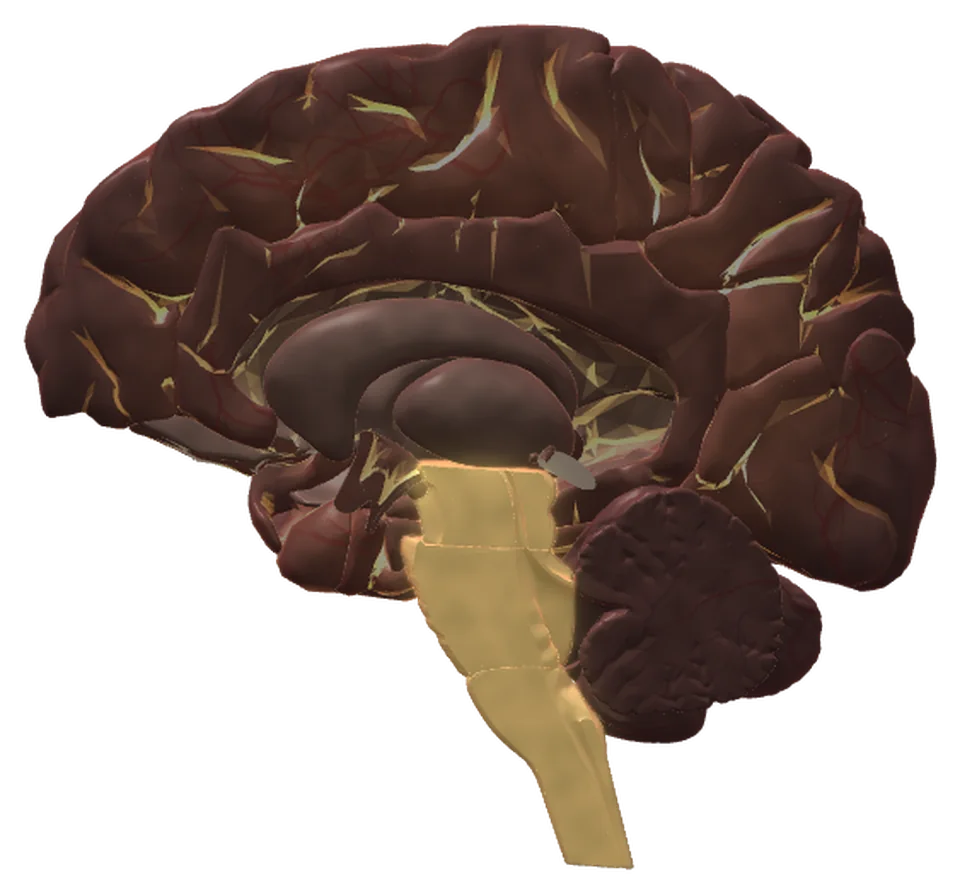
A network in the brainstem, the reticular formation, keeps the rest of the brain awake; stimulating it wakes a sleeping animal.2Historic paperBrain stem reticular formation and activation of the EEGMoruzzi, G. & Magoun, H. W. · 1949 When you feel sleepy is set by a body clock in the hypothalamus.3Peer-reviewed studyTransplanted suprachiasmatic nucleus determines circadian periodRalph, M. R., Foster, R. G., Davis, F. C. & Menaker, M. · 1990
Night-time cleaning
In mice, the spaces between brain cells widened by about 60% during sleep, and waste products, including a protein linked to Alzheimer's disease, were cleared out faster than when the animals were awake.4Peer-reviewed studySleep drives metabolite clearance from the adult brainXie, L. et al. · 2013
Working on memories
Sleep also seems to help store what you learned during the day.5TextbookPrinciples of Neural Science, 6th editionKandel, E. R., Koester, J. D., Mack, S. H. & Siegelbaum, S. A. · 2021 Yet during REM sleep, the brainstem cells that release noradrenaline fall almost silent,6Peer-reviewed studyActivity of norepinephrine-containing locus coeruleus neurons in behaving rats anticipates fluctuations in the sleep-waking cycleAston-Jones, G. & Bloom, F. E. · 1981 which may be one reason dreams are so easily forgotten. Read more in why we forget our dreams.