What it does
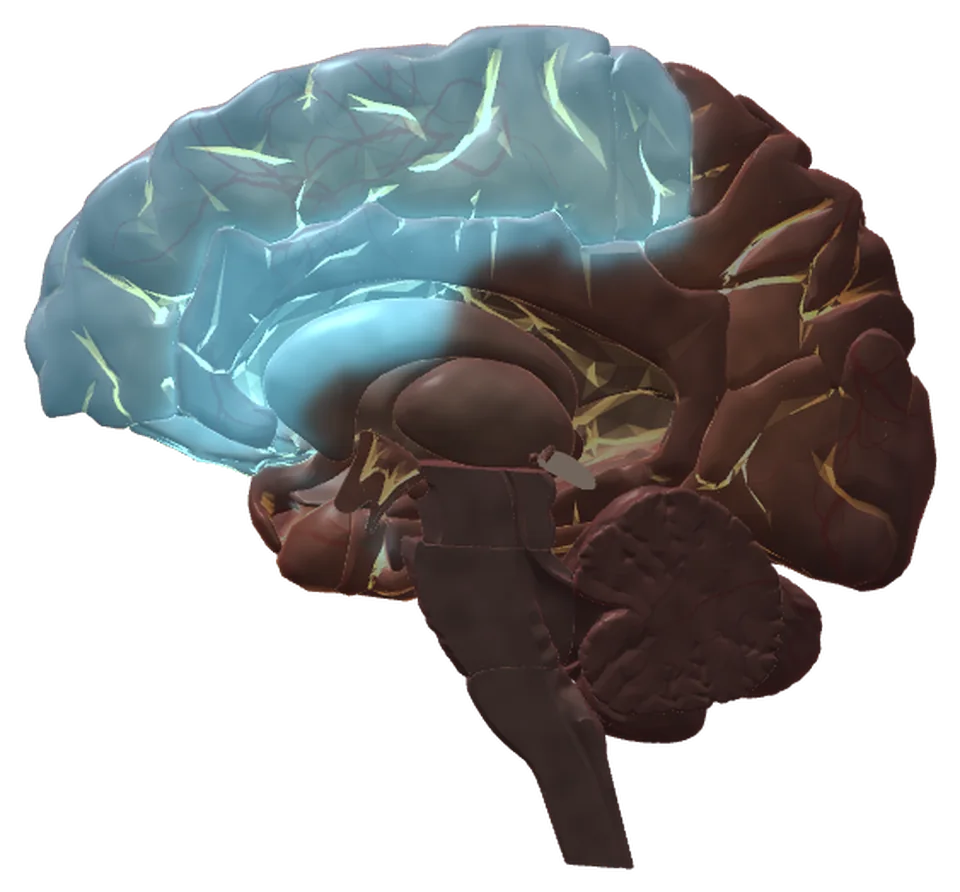
The front part, the prefrontal cortex, is where you plan ahead, keep things in mind for a few seconds and stop yourself from acting on every impulse. Further back, the primary motor cortex sends the commands for voluntary movement to the opposite side of the body.1TextbookPrinciples of Neural Science, 6th editionKandel, E. R., Koester, J. D., Mack, S. H. & Siegelbaum, S. A. · 2021
On the left side in most people, Broca's area turns ideas into spoken words.2Historic paperRemarques sur le siège de la faculté du langage articuléBroca, P. · 1861
When it is damaged
In 1848 an iron rod passed through the frontal lobe of railway worker Phineas Gage. He survived, but people who knew him said his personality changed: he became impulsive and struggled to plan.3Historic paperRecovery from the passage of an iron bar through the headHarlow, J. M. · 1868
Damage to Broca's area causes Broca's aphasia: speech becomes slow and effortful, while understanding is mostly kept.2Historic paperRemarques sur le siège de la faculté du langage articuléBroca, P. · 1861 Damage to the motor cortex causes weakness on the opposite side of the body.1TextbookPrinciples of Neural Science, 6th editionKandel, E. R., Koester, J. D., Mack, S. H. & Siegelbaum, S. A. · 2021
Growing up
Brain scans of children followed into adulthood show that the frontal lobe, especially the prefrontal cortex, is among the last parts of the cortex to mature.4Peer-reviewed studyDynamic mapping of human cortical development during childhood through early adulthoodGogtay, N. et al. · 2004
Parts of the frontal lobe
Prefrontal cortex
Planning, self-control and working memory.
Primary motor cortex
Sends the commands for voluntary movement.
Broca's area
Producing speech, usually on the left side.
Orbitofrontal cortex
Weighing rewards and making choices.