The question
You probably dream several times every night, yet most mornings you remember little or nothing. Even a vivid dream often fades within minutes of getting up. Forgetting dreams is not a sign that something is wrong: it seems to be how the sleeping brain is built.
Dreaming in a brain that is not saving
The most vivid dreams happen during REM sleep, when the eyes dart about under closed lids. When researchers woke people during REM in the 1950s, they usually reported a dream; woken in other stages, they rarely did.1Peer-reviewed studyThe relation of eye movements during sleep to dream activity: an objective method for the study of dreamingDement, W. & Kleitman, N. · 1957
During REM, the locus coeruleus, a small cluster in the brainstem that releases noradrenaline, goes almost completely silent.2Peer-reviewed studyActivity of norepinephrine-containing locus coeruleus neurons in behaving rats anticipates fluctuations in the sleep-waking cycleAston-Jones, G. & Bloom, F. E. · 1981 Noradrenaline normally helps the brain mark experiences as worth keeping.3TextbookPrinciples of Neural Science, 6th editionKandel, E. R., Koester, J. D., Mack, S. H. & Siegelbaum, S. A. · 2021 So the brain dreams at the moment it is least set up to remember.
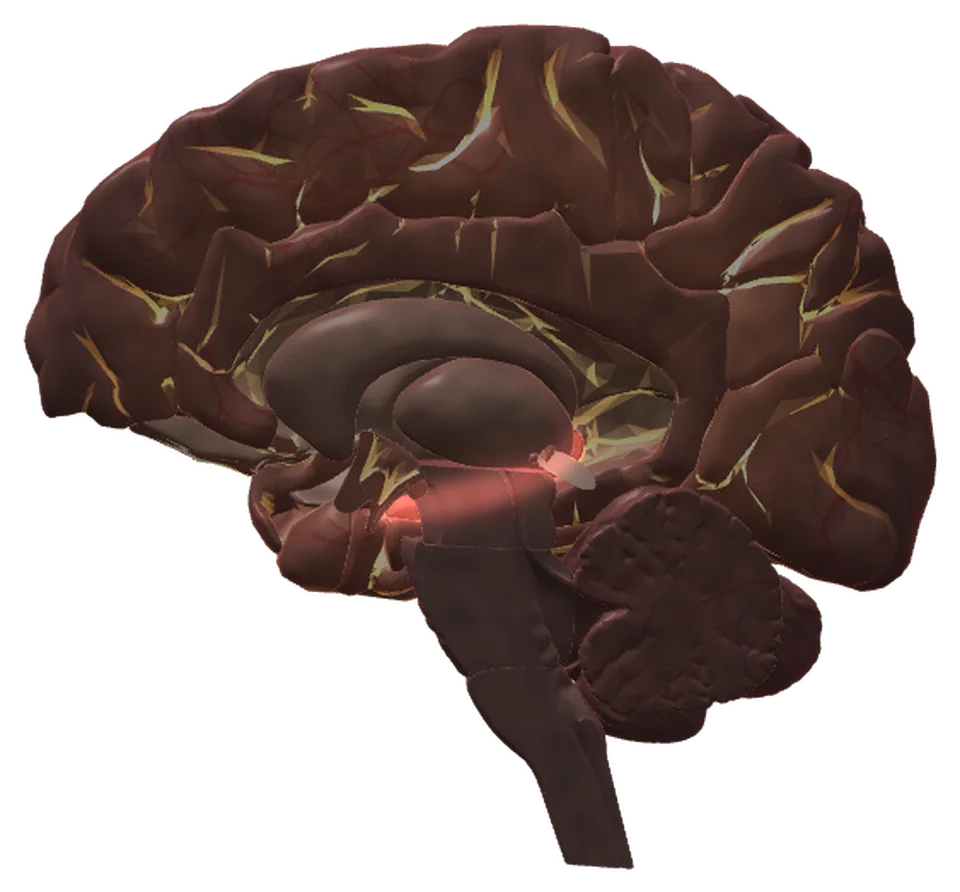
An active forgetting switch
Forgetting may even be deliberate. In mice, neurons in the hypothalamus that make a hormone called MCH become active during REM sleep. Switching them on during REM made the mice worse at remembering things that depend on the hippocampus; switching them off made them better.4Peer-reviewed studyREM sleep-active MCH neurons are involved in forgetting hippocampus-dependent memoriesIzawa, S. et al. · 2019
The researchers suggest this may help explain why dreams are forgotten, but it has not yet been shown in people.
Can you remember more?
Because a dream fades so quickly, the few minutes after waking matter most. People who want to recall more dreams often keep a notebook by the bed, lie still with their eyes closed and replay the dream before doing anything else, then write it down straight away.