Seeing is guessing
Your eyes send the brain a flat, upside-down image that is sharp only in the centre. From this, the brain builds a stable, three-dimensional world, filling gaps using assumptions about how the world usually is.1TextbookPrinciples of Neural Science, 6th editionKandel, E. R., Koester, J. D., Mack, S. H. & Siegelbaum, S. A. · 2021
Built from edges
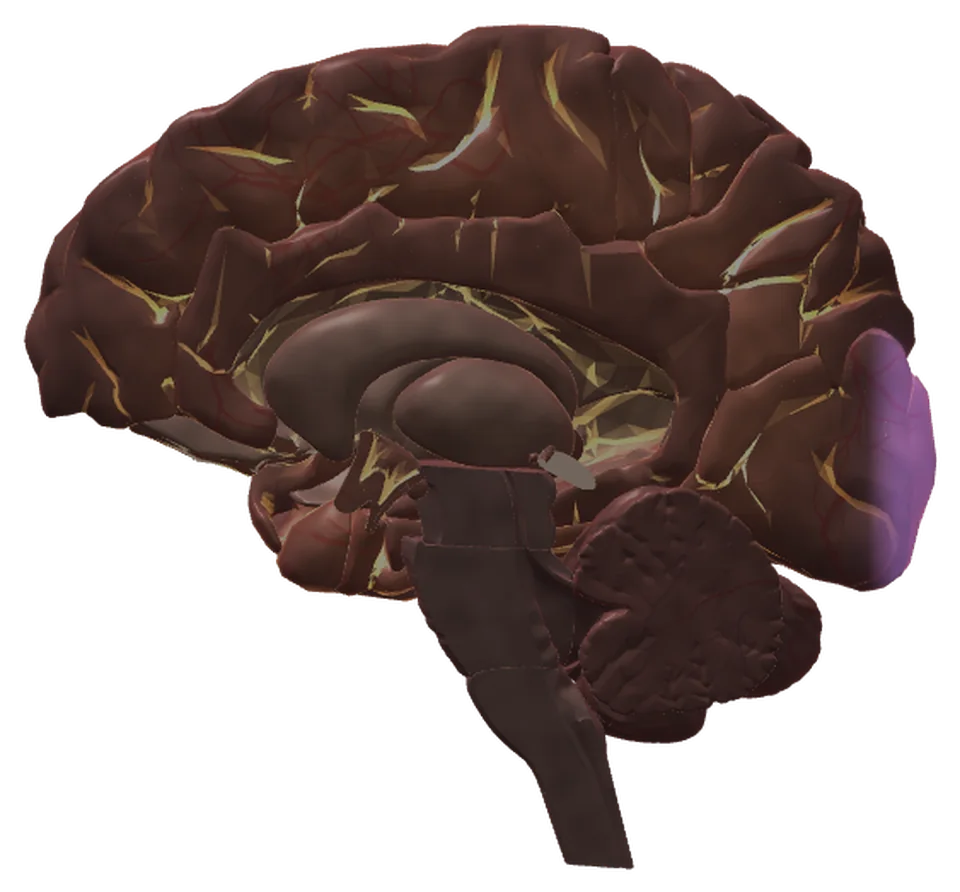
In the primary visual cortex, neurons respond to lines and edges at particular angles.2Peer-reviewed studyReceptive fields, binocular interaction and functional architecture in the cat's visual cortexHubel, D. H. & Wiesel, T. N. · 1962 Later areas combine these into shapes, colours, motion and finally objects and faces.1TextbookPrinciples of Neural Science, 6th editionKandel, E. R., Koester, J. D., Mack, S. H. & Siegelbaum, S. A. · 2021
The hole you never notice
Each eye has a blind spot where the optic nerve leaves it; there are no light sensors there. You never see a hole because the brain fills it in.1TextbookPrinciples of Neural Science, 6th editionKandel, E. R., Koester, J. D., Mack, S. H. & Siegelbaum, S. A. · 2021 Try it: close your left eye, look at the cross with your right eye and slowly move toward or away from the screen. At one distance, the dot disappears.
Light from above
The brain assumes light comes from above. Shading that is bright on top looks like a bump; bright on the bottom looks like a dent.3Peer-reviewed studyPerception of shape from shadingRamachandran, V. S. · 1988 Flip the picture and watch them swap.
Seeing without knowing
Some people with damage to the visual cortex can point to things they insist they cannot see, an effect called blindsight.4Peer-reviewed studyVisual capacity in the hemianopic field following a restricted occipital ablationWeiskrantz, L., Warrington, E. K., Sanders, M. D. & Marshall, J. · 1974 Seeing and knowing that you see are not quite the same thing.