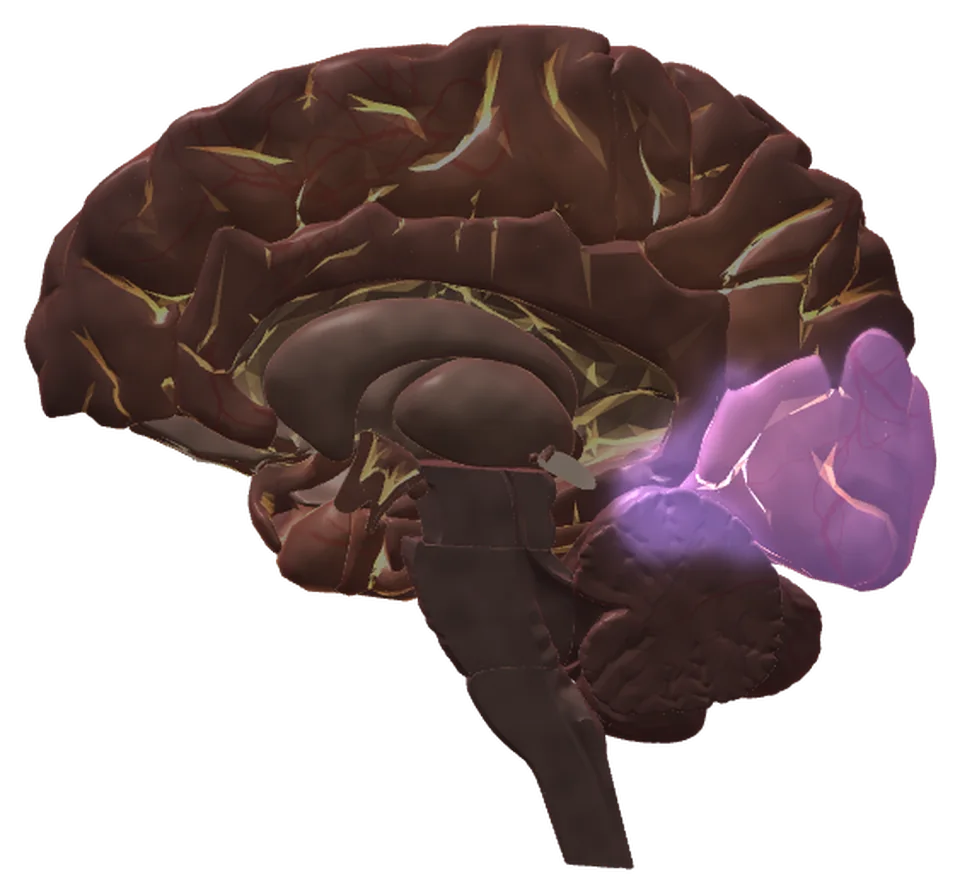
What it does
Signals from the eyes reach the primary visual cortex (V1) after a stop in the thalamus. In the 1960s, Hubel and Wiesel found that neurons here respond to edges at particular angles, the building blocks of everything you see.1Peer-reviewed studyReceptive fields, binocular interaction and functional architecture in the cat's visual cortexHubel, D. H. & Wiesel, T. N. · 1962
From V1, information spreads to areas that specialise in colour, shape and motion.2TextbookPrinciples of Neural Science, 6th editionKandel, E. R., Koester, J. D., Mack, S. H. & Siegelbaum, S. A. · 2021
When it is damaged
Damage to one side causes blindness in the opposite half of what both eyes see. Remarkably, some people with this damage can still point to objects in their blind area while saying they see nothing, an effect called blindsight.3Peer-reviewed studyVisual capacity in the hemianopic field following a restricted occipital ablationWeiskrantz, L., Warrington, E. K., Sanders, M. D. & Marshall, J. · 1974
Parts of the occipital lobe
Primary visual cortex (V1)
Detects edges and their angles.
V4
Processes colour and shape.
V5 (MT)
Processes motion.