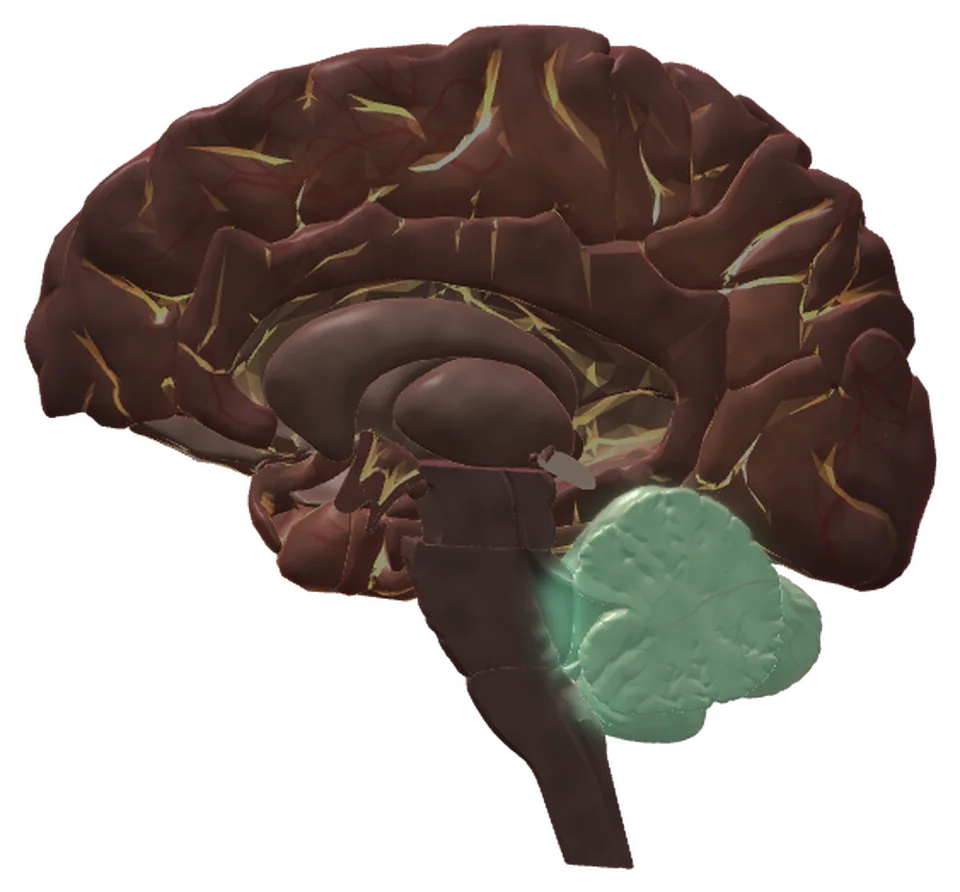
What it does
The cerebellum compares the movement you meant to make with the one you are actually making, and corrects the difference. It is why practice makes movements smooth and automatic.1TextbookPrinciples of Neural Science, 6th editionKandel, E. R., Koester, J. D., Mack, S. H. & Siegelbaum, S. A. · 2021
Although it is far smaller than the cerebral cortex, it contains around 69 billion of the brain's 86 billion neurons.2Peer-reviewed studyEqual numbers of neuronal and nonneuronal cells make the human brain an isometrically scaled-up primate brainAzevedo, F. A. C. et al. · 20093Peer-reviewed studyCoordinated scaling of cortical and cerebellar numbers of neuronsHerculano-Houzel, S. · 2010
When it is damaged
Damage causes ataxia: clumsy, unsteady movement, a wide stagger when walking, slurred speech and a tremor that gets worse as the hand nears its target. Because of how its wiring crosses, problems appear on the same side as the damage.1TextbookPrinciples of Neural Science, 6th editionKandel, E. R., Koester, J. D., Mack, S. H. & Siegelbaum, S. A. · 2021
Parts of the cerebellum
Vermis
Posture and balance of the trunk.
Cerebellar hemispheres
Smooth, accurate movement of the limbs.
Flocculonodular lobe
Balance and eye movements.
Deep cerebellar nuclei
Carry the cerebellum's output to the rest of the brain.