Two areas, two jobs
In 1861 Paul Broca described a patient who understood speech but could barely speak, with damage in the left frontal lobe.1Historic paperRemarques sur le siège de la faculté du langage articuléBroca, P. · 1861 In 1874 Carl Wernicke described the opposite: fluent speech that made little sense and poor understanding, after damage further back in the left temporal lobe.2Historic paperDer aphasische SymptomencomplexWernicke, C. · 1874
These became known as Broca's area and Wernicke's area.
Mostly on the left
In most people, language depends mainly on the left side of the brain. In a study of healthy volunteers, language was mainly on the right in about 4% of strong right-handers and 27% of strong left-handers.3Peer-reviewed studyHandedness and hemispheric language dominance in healthy humansKnecht, S. et al. · 2000
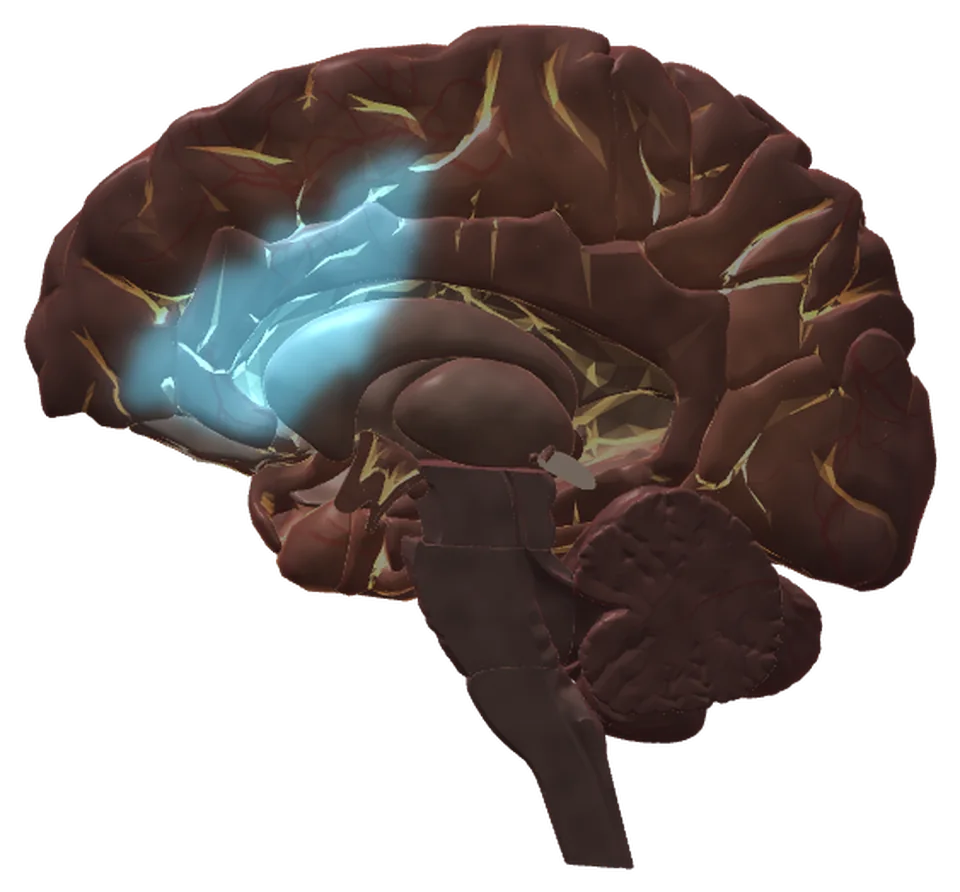
Not just about sound
Deaf signers with damage to the same left-side areas develop the same kinds of language problems in sign language.4Peer-reviewed studyThe neurobiology of sign language and its implications for the neural basis of languageHickok, G., Bellugi, U. & Klima, E. S. · 1996
More than two spots
Today we know language uses a wide network, linked by bundles of fibres such as the arcuate fasciculus.5TextbookPrinciples of Neural Science, 6th editionKandel, E. R., Koester, J. D., Mack, S. H. & Siegelbaum, S. A. · 2021 Even Broca's own patient had damage that reached deeper than he could see: MRI scans of the preserved brain showed it in 2007.6Peer-reviewed studyPaul Broca's historic cases: high resolution MR imaging of the brains of Leborgne and LelongDronkers, N. F., Plaisant, O., Iba-Zizen, M. T. & Cabanis, E. A. · 2007